Peter's electronic projects Peter's electronic projects
Advice on how to modify the General Conditions without causing conflict.
Disclaimer: This article provides an overview based on the announced publications by FIDIC in late 2022/2023. Always consult the official, current FIDIC documents for contractual advice.
Visual tools mapping out complex contractual timelines, such as payment cycles, claims notification windows, termination procedures, and DAAB referral steps. 5. Navigating PDF Formats and Intellectual Property fidic contracts guide 2nd edition 2022 pdf
The FIDIC Contracts Guide 2nd Edition 2022 is a comprehensive resource that provides guidance on the use of FIDIC contracts. The guide is designed to help users understand the FIDIC contracts and their application in various project scenarios. The guide covers the following topics:
The guide is split into two volumes. It employs a three-column layout for ease of reference, allowing users to follow the text of the contracts alongside the explanatory commentary. Advice on how to modify the General Conditions
For those familiar with previous FIDIC literature, the 2022 Guide offers several distinct improvements:
The guide focuses on the three main books of the Rainbow Suite, which serve different procurement needs: Visual tools mapping out complex contractual timelines, such
The most significant aspect of the 2022 Guide is its role as a translator. For twenty years (1999–2017), the industry relied on the "Rainbow Suite." When FIDIC released the 2017 editions, the changes were seismic—shifting from a "claims-based" approach to a "dispute avoidance" mechanism.
Electrical, mechanical, and process plant installations, as well as building/engineering works designed by the Contractor.
It allows the user to instantly compare the 1999 wording with the 2017 wording, ensuring that they do not accidentally rely on obsolete interpretations during a crucial negotiation.
When FIDIC released the 2017 editions of the Red, Yellow, and Silver Books, they moved from a philosophy of "fit for purpose" to a rigorous focus on front-end management and procedural compliance.
 Try it now, before building! Click on the transmitter buttons with the
green
labels
on the left and see how the receiver outputs (K1-K8) change. Change
the number of transmitter or receiver channels. Switch the receiver
output type between latched and momentary.
Try it now, before building! Click on the transmitter buttons with the
green
labels
on the left and see how the receiver outputs (K1-K8) change. Change
the number of transmitter or receiver channels. Switch the receiver
output type between latched and momentary.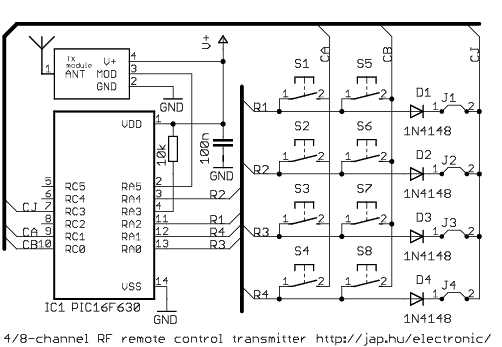
| part | description |
| C1 |
100nF ceramic capacitor |
| R1 |
10k resistor (1/8W) |
| D1-D4 | 1N4148 diode (optional) |
| S1-S8 |
tact switch, DTSM 61N or similar |
| IC1 | PIC16F630 or PIC16F676 microcontroller, pre-programmed |
| TXMOD |
radio
transmitter module, see text (hardware) |
| B1 |
battery between 2-5.5VDC (check TXMOD specs for valid voltage range) |
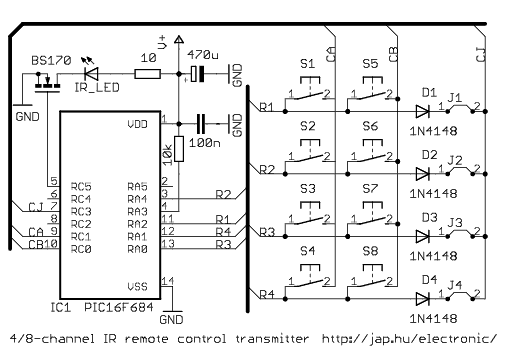
| part | description |
| C1 |
100nF ceramic capacitor |
| C2 |
470 uF 6.3V, electrolytic
capacitor |
| R1 |
10k resistor (1/8W) |
| R2 |
10 ohm resistor (1/4W) |
| D1-D4 | 1N4148 diode (optional) |
| D5 |
IR transmitter LED |
| Q1 |
BSS138 or similar N-MOSFET |
| S1-S8 |
tact switch, DTSM 61N or similar |
| IC1 | PIC16F684 microcontroller, pre-programmed |
| B1 |
battery between 2-5.5VDC (CR2032, 3.6V LiIon battery or 3xAA
batteries) |
| please
observe the corresponding address configuration! |
|
 transmitter: no diodes connected |
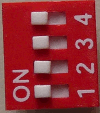 receiver: switches all ON |
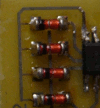 transmitter: all diodes connected |
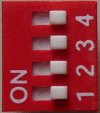 receiver: switches all OFF |
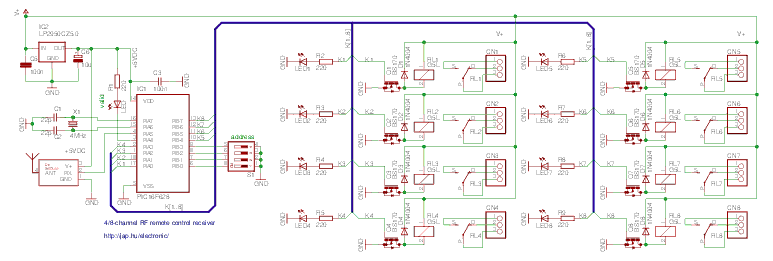
parts list
| part | description |
| C1, C2 | 22pF ceramic capacitor |
| C3, C5 | 100nF ceramic capacitor |
| C6 | 10uF 6.3V electrolytic capacitor |
| CN1-CN8 | PCB terminal block, 3-way (DG301) |
| D1-D8 | 1N4004 diode |
| IC1 | PIC16F627 or PIC16F628 or PIC16F627A or PIC16F628A microcontroller, pre-programmed |
| IC2 | LP2950CZ5.0 voltage regulator |
| LED | 3mm LED (green) |
| LED1-LED8 | 3mm LED (red) |
| Q1-Q8 | BS170 N-channel mosfet transistor |
| R1-R9 | 220R resistor (1/8W) |
| RL1-RL8 | G5LE relay, see text for coil voltage selection |
| S1 | piano DIP switch, 4-way |
| X1 | 4MHz HC49 crystal |
| RXMOD | 3-pin radio receiver module, see text (hardware) |
| please
observe the corresponding address configuration! |
|
| transmitter: no diodes connected |
receiver: switches all ON |
| transmitter: all diodes connected |
receiver: switches all OFF |
Advice on how to modify the General Conditions without causing conflict.
Disclaimer: This article provides an overview based on the announced publications by FIDIC in late 2022/2023. Always consult the official, current FIDIC documents for contractual advice.
Visual tools mapping out complex contractual timelines, such as payment cycles, claims notification windows, termination procedures, and DAAB referral steps. 5. Navigating PDF Formats and Intellectual Property
The FIDIC Contracts Guide 2nd Edition 2022 is a comprehensive resource that provides guidance on the use of FIDIC contracts. The guide is designed to help users understand the FIDIC contracts and their application in various project scenarios. The guide covers the following topics:
The guide is split into two volumes. It employs a three-column layout for ease of reference, allowing users to follow the text of the contracts alongside the explanatory commentary.
For those familiar with previous FIDIC literature, the 2022 Guide offers several distinct improvements:
The guide focuses on the three main books of the Rainbow Suite, which serve different procurement needs:
The most significant aspect of the 2022 Guide is its role as a translator. For twenty years (1999–2017), the industry relied on the "Rainbow Suite." When FIDIC released the 2017 editions, the changes were seismic—shifting from a "claims-based" approach to a "dispute avoidance" mechanism.
Electrical, mechanical, and process plant installations, as well as building/engineering works designed by the Contractor.
It allows the user to instantly compare the 1999 wording with the 2017 wording, ensuring that they do not accidentally rely on obsolete interpretations during a crucial negotiation.
When FIDIC released the 2017 editions of the Red, Yellow, and Silver Books, they moved from a philosophy of "fit for purpose" to a rigorous focus on front-end management and procedural compliance.
LATCH_MASK EQU B'00001111' sets channels 8-5 to momentary
and
channels 4-1 to latched (toggle) mode. Then use the compiler (MPLAB or
gputils) to
assemble the code.clrf
0x91 ;
ANSEL